Every removal ends with the same question: what about the stump? You can leave it, grind it or dig it out, and the right answer depends on what you want to do with the spot. After grinding hundreds of stumps in Syracuse yards, from tight city lots in Westcott to open acreage in Manlius, here is how we explain the choice at the estimate.
What stump grinding is
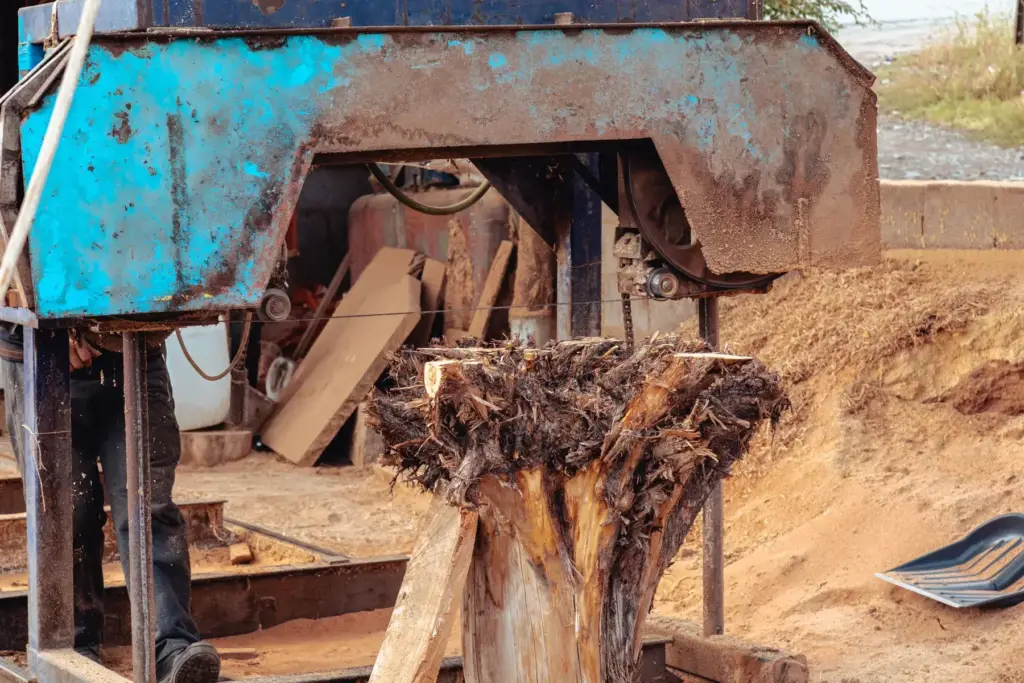
A stump grinder is a machine with a spinning steel wheel studded with carbide teeth. The operator sweeps the wheel back and forth across the stump, chewing it into chips, then works down and out to chase the flare roots. A standard grind takes the stump six to twelve inches below grade. The deeper roots stay in the ground and decay naturally over the following years.
What you are left with is a shallow depression full of wood chips and soil. We can rake the chips out, backfill with topsoil and seed, and within a season you cannot tell there was ever a tree. The whole job on an average stump takes well under an hour. Our stump grinding page lists exactly what is included.
What stump removal is
Stump removal, sometimes called stump extraction, means digging the entire root ball out of the ground. On a small tree that can be done by hand or with a mini excavator. On a mature maple with a root plate eight feet across, it takes a full sized excavator, a truck to haul the root ball, and a lot of fill to close the hole. It tears up the lawn around it, it can disturb buried lines, and it costs several times what grinding costs.
It has its place. When we are doing land clearing for a building site, the builder usually wants stumps and root balls gone so the ground can be graded and compacted. In a residential yard, full removal is rarely the right call.
Grinding vs removal at a glance
| Stump grinding | Stump removal | |
|---|---|---|
| Method | Grinder chips the stump in place | Excavator digs out the whole root ball |
| Depth | 6 to 12 inches below grade, deeper on request | Entire root mass, often 2 to 3 feet |
| Time | Under an hour for most stumps | Half a day or more |
| Disturbance | Small area, lawn intact around it | Large hole, lawn and beds torn up |
| Roots | Lateral roots chased, deep roots decay naturally | Roots removed |
| Best for | Lawns, beds, most residential yards | Building sites, driveways, foundations |
| Cost | Lowest | Several times higher |
When grinding is the right choice
- You want lawn. Grind, backfill, seed. Done. This is 90 percent of the stumps we do.
- You want a flower bed. A standard grind leaves plenty of depth for perennials and shrubs.
- The stump is near a fence, walk or foundation. The grinding wheel can work within a few inches of a hard surface. An excavator cannot.
- The stump is in a fenced backyard. Our narrow access grinders fit through a standard gate. An excavator needs the fence down.
- Suckers keep coming up. Maples, locusts, poplars and lilacs resprout from a stump for years. Grinding out the stump and the flare roots stops it.
When you might want full removal
- You are building on the spot. A patio, a driveway, an addition or a shed foundation needs stable, compacted ground with no decaying wood under it.
- You are planting a new tree in the exact same hole. Even then, a deep grind (18 inches or more) with the chips fully removed is usually enough. We do this often.
- The stump is part of a larger clearing job where the excavator is already on site.
What about leaving the stump?
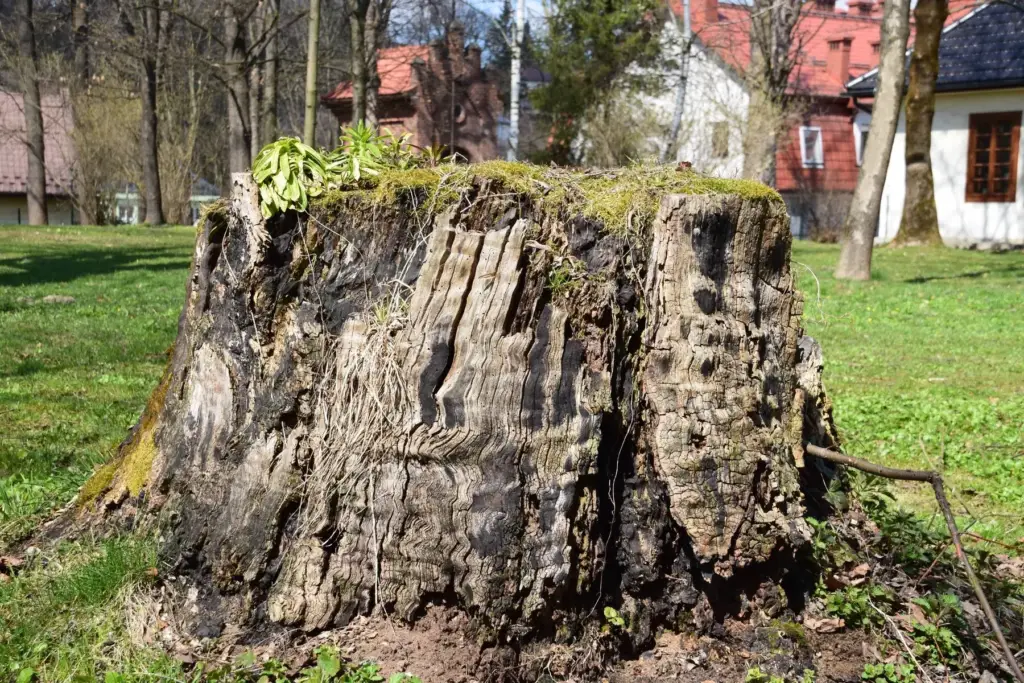
You can. Plenty of people do. Here is what happens. The stump rots slowly, which in our climate means ten to twenty years for a big hardwood. While it rots it feeds carpenter ants and fungi like honey fungus, which spread through the soil to nearby trees and to the sill plate of a wooden fence or a shed. It is a trip hazard, it is a mowing obstacle, and it sends up suckers. And a stump that is 24 inches across and a foot tall is surprisingly hard to hide.
The one good reason to leave a stump is wildlife: a rotting stump in a back corner of a big property is a fine habitat. In a suburban lawn it is just a stump.
What happens to the roots after grinding
This is the question people worry about most. The answer is that they decay, harmlessly, over a few years. Roots left in the ground do not grow. Without the crown to feed them, a tree’s roots die within months. The exception is species that sucker from roots, like black locust, poplar and sumac, and even those give up once the stump and the main lateral roots are ground out. If a stray sucker appears, cut it off at the ground and it will not come back.
The chips from the grind are a mix of wood and soil. You can leave them as mulch, but do not fill the hole with them and seed on top. Decaying chips pull nitrogen from the soil, the grass will be yellow and thin, and the hole will settle as the chips break down. Rake the chips out, backfill with clean topsoil, then seed or sod. That is what we do by default.
How deep should you grind?
Six inches below grade is enough for lawn. Grass roots live in the top few inches and the mower never knows the difference. Twelve inches is what we do by default because it gives room for a proper layer of topsoil and it takes out more of the flare, which is what keeps the spot from sinking later. Eighteen inches or more is for planting a new tree in the same spot, or for a fence post or a paver base that needs solid ground. Deeper grinding costs a little more and takes a little longer, so tell us the plan for the spot at the estimate and we will grind to match it.
Chasing the surface roots matters as much as depth. A big maple sends flare roots out three or four feet across the lawn, just under the surface. If we only grind the stump and leave those, you have a flat spot with a ring of ridges around it that the mower catches for years. We follow each visible root out until it drops below grade.
Stumps in tight and awkward spots
Syracuse city lots put stumps in odd places: between the house and the driveway, tight against a chain link fence, in a bed full of hostas, on a slope down to the sidewalk. Most of it is fine. The cutting wheel is narrow, the machine turns in its own length, and an experienced operator can grind within a couple of inches of a foundation. We protect nearby surfaces with plywood, cover windows if the stump is close to the house, and set up a chip barrier so nothing goes into the neighbor’s yard. Very steep slopes and stumps inside a low deck are the two cases where we might recommend a different approach, and we will say so on the estimate.
Utilities, sprinklers and the thing we always check first
Before any grinding near a service line, we call Dig Safely New York for a utility locate. It is free, it is the law for excavation, and a gas line is not something to find with a stump grinder. We also ask about irrigation, invisible dog fences and buried downspout drains, which the locate service does not mark. Tell us at the estimate and we will work around them.
What stump grinding costs in Syracuse
Pricing is by the stump, driven by its diameter at the ground, how many surface roots need chasing, and access. A small ornamental stump is inexpensive. A big silver maple with a wide flare is more. If we are already on site for a removal, adding the grind is the most economical way to do it because the equipment is already there. Multiple stumps on one visit are priced together. Every job gets a written number before we start, and there is never a fee for looking.
How to prepare
- Clear anything movable from around the stump: planters, furniture, garden ornaments.
- Mark sprinkler heads and dog fence wire with flags if you know where they are.
- Decide whether you want the chips hauled or left, and whether you want topsoil and seed.
- Keep pets and kids inside while the machine is running. Grinders throw chips.
The Arbor Day Foundation planting guides are useful if the plan is a new tree in the newly cleared spot, and we are happy to grind deeper for that when you tell us in advance.
If you have a stump, or a tree that is about to become one, request a free estimate. We will look at it, tell you honestly which option fits, and give you a price in writing.